Why Are CS2 Skins So Expensive? The Seven Price Drivers, With Dated Numbers
CS2 skins are expensive because their supply is fixed or shrinking while demand keeps coming. Knives and gloves come out of cases at about one opening in 385, older cases stopped dropping years ago, a few floats, patterns and stickers are one of a kind, and Valve can change the rules overnight. Most skins are not expensive at all; a small top tier is.
That last point is the one the ranking pages skip. The cheapest Kilowatt Case on Steam cost 15 cents on 13 October 2026, and thousands of finishes sell for under a dollar. This file explains the seven forces that push the top tier up, each with one dated number, so you can tell which of them is behind a price you are looking at.
The short answer, as a diagram
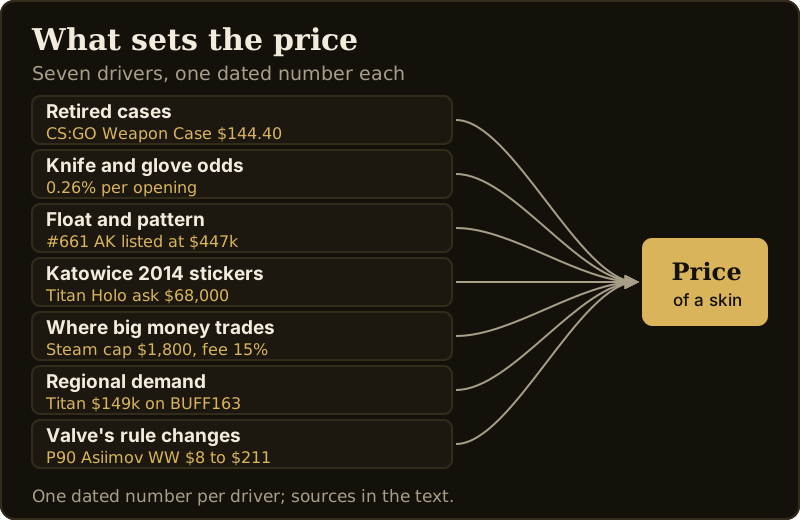
The seven are not equally important for every item. A cheap Field-Tested rifle skin is priced almost entirely by supply and demand for that finish. A five-figure knife is priced by its pattern and float. A six-figure craft is priced by its stickers and by the handful of people able to buy it. Knowing which lever applies is most of the work of reading a price.
Supply: cases that stopped dropping
Every case has a supply tap, and Valve controls it. While a case is in the weekly drop, new copies arrive every week and the price stays low. Once it leaves, the only new supply is whatever trickles out of a rare pool that Valve does not document, and openings destroy copies. The price gap that results is enormous.
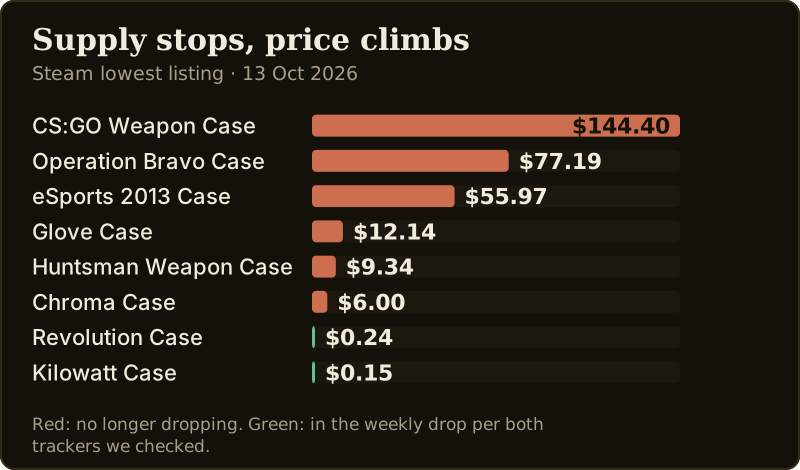
The original CS:GO Weapon Case listed at $144.40 on 13 October 2026, nearly a thousand times the Kilowatt Case. Nothing inside the old case is better; it is simply scarcer, and every skin that can only come from it inherits that scarcity. The Glove Case, the first case with gloves, released on 28 November 2016, sat at $12.14 the same day.
The gold door: 0.26% odds for knives and gloves
Knives and gloves were, until October 2025, only obtainable by opening a case. Under the odds Valve published for its China release in 2017, a rare special item comes out of 0.26% of openings, about one in 385. With each opening costing a case plus a key that players report at US$2.49, the expected spend behind every knife or glove runs to about $1,000 or more, even through the cheapest case still dropping, before anyone has chosen which one they want.
That cost kept knives scarce for a decade. Since the October 2025 trade-up change their floor also follows the price of five Coverts, and the cheapest Safari Mesh knife, a Field-Tested Navaja, still listed at $42.93 on Steam on 13 October 2026. The most expensive CS2 knife page shows what sits at the other end of the range.
Rarity inside a skin: float and pattern
Two copies of the same knife can differ in price by a factor of a hundred. The float, fixed at creation, sets wear; the pattern seed sets how the design falls. For finishes such as Case Hardened, Doppler and Fade, a handful of patterns are worth multiples of the rest. The best-documented example is pattern 661 on the AK-47 | Case Hardened.
A StatTrak Minimal Wear copy of that pattern, carrying four Titan Holo stickers, was bought in 2021 for around $150,000 and listed in November 2022 at €431,000, about $447,000, according to Dexerto. An ordinary Case Hardened AK costs a small fraction of that. The pattern record and its later history are covered in the AK-47 blue gem file.
Stickers and crafts
Stickers from the first Major, Katowice 2014, are the scarcest paper in the game, and they make some crafted skins worth more than the gun underneath. On 13 October 2026 the cheapest Titan (Holo) listed at $68,000, while the best bid anywhere SteamDB.com tracks was $20,000. That spread says as much about these prices as the headline number: a few buyers, fewer sellers, and quotes set one listing at a time.
Applying a sticker consumes it, so every craft shrinks the supply further. The ranking of the most expensive examples, and why nothing from later Majors comes close, belong to the rarest Katowice 2014 stickers record.
Where big money trades: Steam's cap and fees
Steam caps any single Community Market listing at $1,800, caps a Wallet at $2,000 and takes 15% of every sale. Proceeds stay inside Steam. Anything worth more than the cap has to trade elsewhere, on peer-to-peer and regional marketplaces, which SteamDB.com found charge a median seller fee of 2.5% for peer-to-peer venues in data read on 13 October 2026.
That split pushes prices in two directions. Cheap items carry a Steam premium, because sellers there are paid in Wallet funds they cannot withdraw. Expensive items trade where cash comes out, and their prices reflect what a buyer will pay in real money. If you are comparing a high-end price, compare off-Steam listings on venues such as CSFloat and Skinport, which show float and pattern for each item.
Demand: regional markets and the price gap
The market is global, and the same item can be priced very differently by region. On 13 October 2026 the Titan (Holo) sticker's cheapest ask was $68,000 on CSFloat, yet it was listed at $149,432.16 on BUFF163. SteamDB.com lists BUFF163, C5 Game, ECOSteam and Youpin among the 36 marketplaces it prices.
Gaps like that do not close easily, because moving an item between regional platforms takes time, accounts and verification. They do mean that any "price" for a rare item depends on where it is quoted. A record set on one platform may be impossible to repeat on another.
Shocks: what Valve's updates do to prices
Valve can change supply with a patch, and it has. On 22 October 2025 it let five Covert skins be traded for a knife or gloves. Knife prices fell sharply, while Coverts that feed popular collections jumped: a Well-Worn P90 | Asiimov sold for about $8 before the patch, per esports.net, and listed at $211.41 on Steam on 13 October 2026.
The lesson cuts both ways. A rule change can create value in an item overnight and remove it just as fast, and Valve gives no warning and no reasons. The full record of those swings, from the 2016 gambling crackdown to the October 2025 trade-up crash, is in the CS2 skin market crash file.
Why most skins stay cheap
The seven drivers explain the top of the market, and the bottom is just as revealing. SteamDB.com prices 13,739 CS2 items, and one copy of each at its cheapest ask added up to $1,033,694 in its 12 October 2026 snapshot, read on 13 October. Stickers made up 59.7% of that total and knives 25.3%, while 1,427 weapon skins together came to just $57,361, about $40 each on average.
In other words, the expense is concentrated. Stickers and knives together make up about 85% of SteamDB.com's one-of-each total, and ordinary skins from cases still in the drop are plentiful and cheap. When someone says CS2 skins are expensive, they almost always mean the scarce slice, and the scarce slice is exactly where the seven drivers act hardest.
What this means before you buy
Ask which of the seven drivers you are paying for. Scarcity that Valve cannot add to, such as a retired case, a Katowice 2014 sticker or a specific pattern, has historically held better than scarcity a patch can undo. Then look at liquidity: in its 12 October 2026 snapshot SteamDB.com measured a median buy-then-instant-sell loss of 2.7% on knives but 32.7% on stickers, so some expensive items are much harder to turn back into money than others.
None of this makes skins an investment. Prices across the tracked market fell 4.7% at the median between 14 September and 12 October 2026, and the honest risks are set out in is investing in CS2 skins worth it. For the current record holders, see the most expensive CS2 skins board.
Record questions
Why are CS2 knives so expensive?
Why do people pay thousands for CS2 skins?
Do CS2 skins have real value?
Will CS2 skins go down in price?
Why are old CS2 cases so expensive?
Back to the record: the most expensive CS2 skins, ranked, or the CS2 skin market cap over time.