The Rarest CS2 Skins, and the Four Kinds of Rarity (2026)
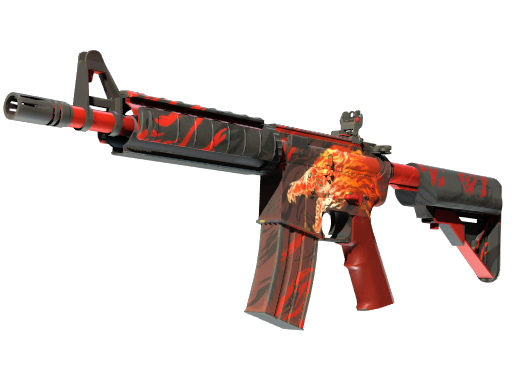
The rarest CS2 skin is the M4A4 Howl, because it is the only Contraband-grade item in the game — a tier that exists solely because Valve had to pull the skin after a copyright dispute. Rarity in Counter-Strike, though, comes in four distinct forms, and the Howl is only the cleanest example of one of them. This file sorts them, because “rarest” and “most expensive” are related but not the same thing.
The four kinds of rarity are discontinued supply, pattern lotteries, float scarcity, and tournament provenance. Some of the most expensive CS2 skins are expensive because they are rare in one of these ways; others are simply beautiful and in demand. Knowing which is which is how you avoid overpaying for a skin that only looks rare.
Discontinued supply: the Howl and the Contraband tier
The purest rarity is a fixed, shrinking population. The M4A4 Howl launched in 2014 as a Covert, then its wolf artwork was found to infringe a designer's work; Valve removed it from all drops and reclassified existing copies as Contraband. No new copies can ever enter the game, and a Factory New sits around a $4,400 median for that reason alone. The Souvenir AWP Dragon Lore is rarer still by count — perhaps 12 to 15 Factory New copies — because it only dropped at Majors on a map, Cobblestone, that left the pool in 2018. The Howl's full story is in the M4A4 Howl contraband history.
Discontinued supply is quietly the strongest long-term rarity, because it only moves one way. Every Contraband Howl that is lost to an abandoned account, and every Souvenir Dragon Lore that stays locked in a collector's inventory, thins a population that can never be topped up. Retired cases and finishes from early operations behave the same way: they are not headline-expensive, but their supply is fixed forever, and time does the rest. When you assess a discontinued skin, the question is not just how many exist today but how fast the count is shrinking.
Pattern lotteries: blue gems and the seed system
Some finishes roll a random pattern at drop, and a few seeds are extraordinary. Case Hardened is the famous one: its blue-and-gold pattern varies by index, and a handful of numbers — #661 on the AK, #387 on the Karambit — carry a near-fully-blue play side worth a multiple of an ordinary copy. This is why a Case Hardened AK can be $100 or $1 million depending on four digits. The mechanism is explained in the AK-47 blue gem and the million-dollar sale.
Case Hardened is not alone. Marble Fade chases the “Fire and Ice” pattern where red and blue meet just so; Crimson Web wants a tight, centred web on the play side; Doppler hunts specific phases. In each case the finish is common and a particular arrangement of it is not, so the price is set by a pattern guide rather than a wear tier. The trap for a buyer is obvious: a listing that quotes a blue-gem-adjacent finish without naming its pattern index is selling you the finish, not the rarity.
Float scarcity: when the wear is the rarity
Every skin has a float value, and for some finishes a clean Factory New is genuinely hard to pull. The Karambit Crimson Web's float range of 0.06–0.80 means low-float copies are scarce by design, which is why its all-time high came after the October 2025 crash, not before. The AK-47 Wild Lotus is rare by raw count — under 3,000 copies exist — and trades $3,800–14,000 by wear, making it the most valuable standard AK finish.
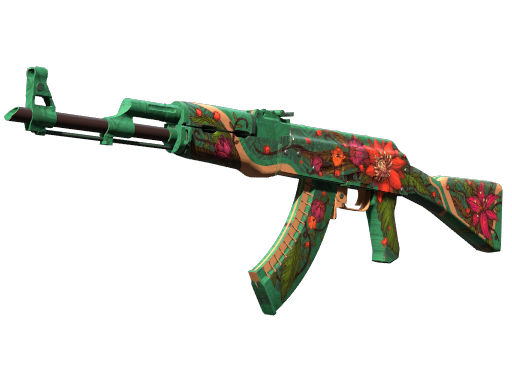
Float scarcity and raw supply often stack. The Wild Lotus is scarce by count and its cleanest copies are scarcer still, so its price ladder climbs steeply from Minimal Wear to Factory New. Contrast that with a Fade, which has no float lottery at all — every copy looks the same — so its rarity is purely about shape and supply. Reading a skin's rarity correctly means knowing which levers are even in play: some finishes are a wear game, some a pattern game, some a supply game, and the priciest are more than one at once.
Tournament provenance: stickers and signatures
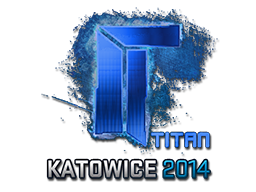
The rarest paper in the game is the Katowice 2014 Holo sticker set. The Titan Holo averages over $125,000 and the iBUYPOWER Holo trades from about $65,000, because they were printed once, never reissued, and are destroyed each time someone applies one. Applied to a legendary skin they compound — the reason a signed Souvenir Dragon Lore clears $400,000. The sticker record is in the rarest CS2 stickers from Katowice 2014.
Provenance rarity is doubly scarce, because both the base item and the sticker must survive. A Souvenir item's tournament stickers cannot be removed or moved, so a specific weapon carries a specific tournament and, sometimes, a specific player's autograph forever. That is why the same finish can be worth a hundred times more with the right four stickers than without them, and why the most expensive individual objects in Counter-Strike are almost always combinations rather than a single skin.
Rare is not the same as expensive
A skin can be rare and cheap if nobody wants it, and common and pricey if everybody does. The Dragon Lore is expensive partly because it is iconic, not only because it is scarce; a genuinely low-population skin from an unloved collection can languish. When you weigh a “rare” claim, ask which of the four rarities applies, whether demand actually exists, and — as always — whether the figure quoted is a sale, an offer or a listing.
This is where record lists mislead most. Ranking skins purely by rarity produces a list nobody would pay those prices for, while ranking purely by price hides why a skin costs what it does. The useful view is both at once: the most expensive CS2 skins board pairs each record figure with the kind of rarity behind it, so you can see whether you are paying for scarcity, for fame, or for a pattern-index accident — and whether anyone has actually paid it.
Record questions
What is the rarest skin in CS2?
Why is the Howl so rare?
What makes a blue gem rare?
Are rare skins always expensive?
Back to the record: the most expensive CS2 skins, ranked, or the CS2 skin market cap over time.