CS2 and CS:GO Skin Market Crash: Every Crash From 2016 to 2026, Charted
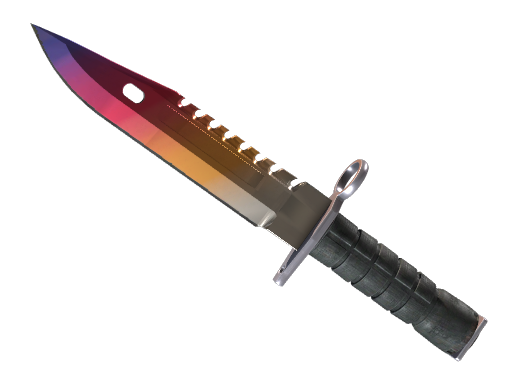
The worst CS:GO and CS2 skin market crash on record began on 22 October 2025, when Valve let players trade five Covert skins for a knife or a pair of gloves. Pricempire's tracker showed the total market cap down 42% within 24 hours, and by 26 October it had fallen from about $6 billion to roughly $3.5 billion. It was not the first crash, and it was not the last.
This file sets every shock side by side, from the 2016 gambling-site crackdown to the May 2026 aftershock and the slow slide since, with each figure filed under the source that measured it. Market-cap trackers disagree with one another and have revised their own history, so a number without a name and a date is not a record. The running total, plotted to scale, lives on the CS2 skin market cap page.
The crashes at a glance
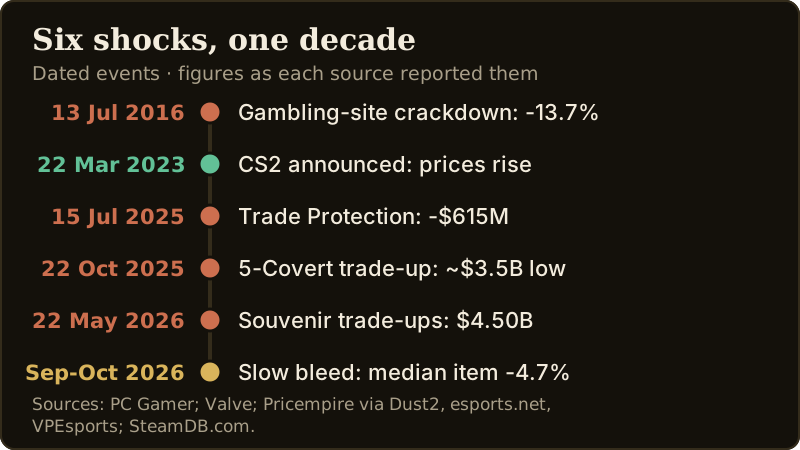
Two patterns run through the decade. Every large fall followed a rule change by Valve rather than a change in how many people play, and every fall before the current slide has been followed by at least a partial rebound. The second pattern is the dangerous one to lean on: a rebound in the total does not mean the item you hold came back, as the price table further down shows.
Keeper's note: a market cap is a model, not a count. Valve publishes no supply figures, so every total multiplies estimated supply by a chosen price. SteamDB.com, which does not publish one, could only compute a floor value of $1,033,694 for one copy of every tracked item in its 12 October 2026 snapshot.
July 2016: the gambling-site crackdown
The first recorded panic came on 13 July 2016, when Valve's Erik Johnson said the company would start sending cease-and-desist requests to gambling websites that ran on Steam's trading system. PC Gamer sampled 20 higher-volume skins and found they fell an average of 13.7% that evening; a Minimal Wear AWP | BOOM went from $21.75 to $18.56 within 12 hours.
The same article noted that most items stopped falling and many returned to their pre-announcement prices within days. When we checked on 13 October 2026, the cheapest Minimal Wear AWP | BOOM on Steam was $121.70, more than five times its pre-panic price. The lesson of 2016 is the template for later shocks: a fear-driven, uniform drop that recovers when the feared outcome does not arrive.
2023: the CS2 announcement and launch
2023 belongs on this list because it moved prices the other way. Valve announced Counter-Strike 2 on 22 March 2023 and confirmed that existing inventories would carry over; WePC reported two days later that skin prices were climbing fast. When CS2 replaced CS:GO on 27 September 2023, Valve also swapped the old weekly drops for a weekly Care Package.
We found no dated, sourced market-cap figure for 2023, so we print none. What later coverage does show is how far the market climbed after it: Dexerto wrote in October 2025 that a $3 billion cap would take values back to 2023 levels, which is the clearest measure of the CS2 run-up we can attribute.
July 2025: Trade Protection
On 15 July 2025 (US time) Valve made Counter-Strike item trades reversible for seven days. The aim was to stop scams, but it also meant a skin that changed hands could come back. Pricempire, as reported by Dust2, had the cap at an all-time high of nearly $5.13 billion on 15 July; it fell every day from 16 July and was $615 million lower by 21 July.
Pricempire put the dip down to liquidity: more skins sat under trade protection and could not move. The rebound started within days, with gains of $73 million on 23 July and $112.5 million on 24 July. The lasting change was operational. Peer-to-peer markets now hold the seller's money until the reversal window closes; CSFloat, for example, credits sellers about eight days after a trade is accepted.
October 2025: knives and gloves from five Coverts
What actually changed
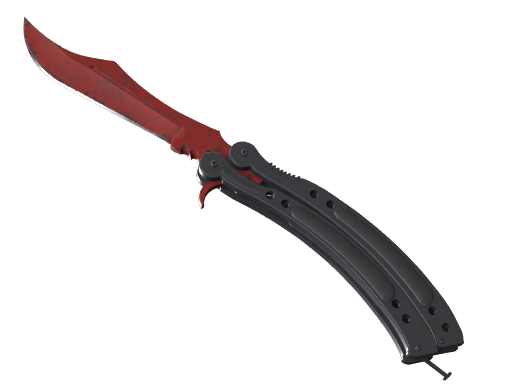
Valve's note, posted at 23:00 UTC on 22 October 2025 and dated the 23rd in most coverage, widened the Trade Up Contract so that five Covert items could become one knife or one pair of gloves, drawn from the collection of any input. Five StatTrak Coverts give a StatTrak knife, and only a knife, because gloves have no StatTrak version. Until then a knife or glove could enter the game only from a case.
The numbers
The estimates arrived in waves. esports.net reported almost $2 billion on 23 October; Eurogamer, citing Pricempire, put the 24-hour fall at 42%. Dexerto described a drop from around $6 billion to $3 billion within 48 hours, while esports.net later logged the bottom at $3.5 billion on 26 October, down 33.69% across 20 to 27 October.
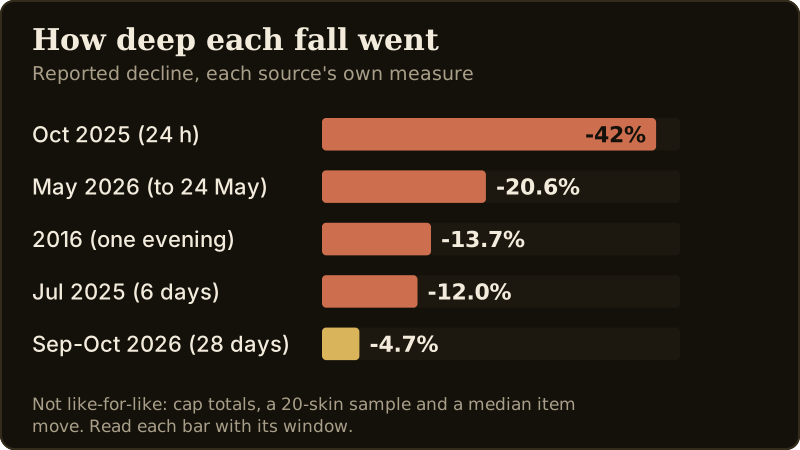
The money did not vanish evenly; it moved. Knives and gloves lost value because anyone holding five Coverts could now make one, and the Coverts themselves became raw material. A Well-Worn P90 | Asiimov that sold for about $8 before the patch traded at $140 to $150 days later, according to esports.net, and Inven Global put the MP9 | Starlight Protector's move at about $3 to about $65.
Why Valve did it
Valve has published no reason. Its note lists the change and nothing else, so any motive in coverage, from giving Coverts a use to pulling trade back onto Steam, is commentary. What the record does show is that Valve left the change in place through the crash and the recovery.
The recovery
The bounce came faster than most forecasts. Dust2, citing Pricempire, reported that the cap gained more than $1 billion between 30 October and 2 November 2025, stayed above $5 billion from the start of November and stood at $5.16 billion on 11 November. Pricempire's explanation was that Covert prices kept climbing faster than knives and gloves kept falling.
So the total recovered largely because value migrated from one category to another. For a holder of knives that is cold comfort: the cap can be back above $5 billion while the specific knife in an inventory is still worth a third less than it was. Where knife records sit today is on the most expensive CS2 knife page.
May 2026: the aftershock
On 22 May 2026 Valve let Souvenir items into Trade Up Contracts; a Souvenir input loses its Souvenir attributes and the output is a normal item one grade up. Two days later VPEsports, citing Pricempire, put the cap at about $4.5 billion, against roughly $5.67 billion at the start of the month, and back near $5.67 billion by 29 May. We could read that report only in summary, so treat all three figures as secondary.
An earlier version of this page blamed that dip on a drop-rate change. That was wrong. None of Valve's 2026 notes changes drop rates or case odds, and VPEsports tied the fall to the 22 May update itself. The size of the move, about a fifth of the cap, came from a rule that touched far fewer items than the October change.
Since then: a slow bleed, not a crash
The months after May are the least dramatic and arguably the most telling. CSMarketCap put the total at $7.1 billion on 4 July 2026, as quoted by SteamDB.com, yet SteamDB.com's own snapshots show the median tracked item falling 9.1% between 12 April and 29 June 2026, with 12,132 of 16,428 qualifying items cheaper at the end.
The latest window runs the same way. Between 14 September and 12 October 2026 the median item across 17,742 qualifying listings moved -4.7%: knives -3.3%, gloves -7.4%, weapon skins -7% and cases -2.5%. A cap figure can rise while most items get cheaper, because a handful of very expensive items dominate it.
Before and after: prices on the items that moved most
Each row below pairs a published before-and-after figure with what the Steam Market showed on 13 October 2026. The early columns come from the coverage named in the source column, so treat them as reported, not audited.
| Item | Before | After | 13 Oct 2026 | Source |
|---|---|---|---|---|
| Butterfly Knife | Crimson Web (WW) | $1,300 | $480 | $1,110.99 | esports.net, Oct 2025 |
| M9 Bayonet | Doppler (wear not stated) | $2,053 | $780 | n/a | Club386, Oct 2025 |
| Safari Mesh knives, cheapest | $100-130 | $40-60 | $42.93 (Navaja FT) | Inven Global, Jul 2026 |
| P90 | Asiimov (WW) | about $8 | $140-150 | $211.41 | esports.net, Oct 2025 |
| MP9 | Starlight Protector | about $3 | about $65 | $77.00 (FT) | Inven Global, Jul 2026 |
| AWP | BOOM (MW), 2016 panic | $21.75 | $18.56 | $121.70 | PC Gamer, Jul 2016 |
Read across and the October crash splits cleanly in two. The knife rows fell hard and have only partly come back; the cheapest Safari Mesh knives still list at under half their pre-crash floor. The Covert rows went the other way and stayed there, because every Covert is now potential trade-up fuel.
What recovered and what didn't
Common knives and gloves are the clear losers. Their price now tracks the cost of five eligible Coverts, and Inven Global reported in July 2026 that the cheapest finishes reprice faster whenever those Coverts get cheaper. Coverts that feed popular collections are the winners, and they now carry a risk they did not have before: their value depends on a rule Valve could change.
Items whose value sits in a specific pattern, phase or float held up best, because a trade-up hands out a random finish and cannot be aimed at one. That is why the blue gems, Dragon Lores and Katowice 2014 stickers on the most expensive CS2 skins board barely registered October as an event. The same logic applies to gloves, covered on the most expensive CS2 gloves page.
Edge cases worth knowing before you buy after a crash
A crash is when prices look cheapest and liquidity is thinnest, and both facts matter. Steam caps any single listing at $1,800 and takes 15% (a 5% Steam fee plus a 10% Counter-Strike 2 fee), with the proceeds locked in a Wallet that cannot exceed $2,000. Anything above that cap trades on outside marketplaces, where Trade Protection means the seller waits about a week for the money.
If you are pricing an item rather than speculating on one, compare the float and pattern on peer-to-peer listings, which CSFloat and Skinport show per item, and check the price on more than one venue. Whether any of this belongs in a portfolio is a separate question, answered without hype in is investing in CS2 skins worth it.
Record questions
Why did CS2 skins crash?
How much did the CS2 market cap drop?
Will CS2 skin prices recover?
What happened to knife prices in CS2?
Did Valve crash the skin market on purpose?
Back to the record: the most expensive CS2 skins, ranked, or the CS2 skin market cap over time.